Sunday, 11 November 2018

October Samples

2018/Week 40, Hedgerow Berries

Another bit created on my Harris holiday. With no sewing machine, I challenged myself to try hedgerow berries again but this time in knitting! I'm not the greatest knitter, but I like to experiment now and then.

I thought felted knitting would suit this, so I searched for pure wool to felt in the washer. I found two shades of green Shetland 4ply for the base, and knitted these together on 4mm needles. In a background of stocking stitch I randomly placed bobbles using a red/pink/orange Twilleys Freedom. (Bobble = k in front, back and front again of 1 st, turn, p3, turn, k3, turn, p3, turn, sl 1 k2tog, psso.)

Once home again I washed it at 60C and it felted pretty well! 

18/41 Car park
My Harris/Lewis holiday photos are full of inspiration for textiles. One of my favourites was this car park, with that metal mesh that's supposed to reinforce and protect the grass. There wasn't much grass left, but the plants looked wonderful in their hexagonal cells.
Back home I hand stitched the wire, used the embellisher to create a mossy effect, and free-machined stylised plants.
 
18/42 Lewisian gneiss
The ancient bedrock of Lewis is gneiss, banded with pink feldspar. The standing stones of Callanish include some beautiful examples. 
Monochrome shows the drama of the stones... but getting in close shows the subtle patterns and colours of the rocks.
This inspired a delicate lacy sample, free-machined on Solufleece. There's no fabric in this, just stitched thread - mostly Rayon 40 with just a little pinky metallic (which hardly shows in the photo).

18/43 Carloway broch 
I've seen a few of these Iron Age towers around the highlands and islands, some in better repair than others. The stonework always seems to follow the same pattern: the gaps between large blocks are filled with stacks and bands of small ones. Now I think about it, our garden wall is just the same!  
 
I used this as an excuse for a bit of wet felting. I'm trying to cure myself of the idea that felting is a messy, time-consuming business that needs a whole day set aside and plastic sheets everywhere. My felt jewellery course in August showed me I can dabble quite spontaneously at my desk. So I made a light grey merino base and decorated the top with bits of darker grey, recycled pink Cheviot, and white bamboo fibres.
 
I backed it with thin wadding, and my design on Solufleece, then free machined the block outlines with charcoal thread.   
     
That's it for October, but I haven't finished with my holiday snaps yet!
 

Wednesday, 10 October 2018

September samples

18/36 Purple flowers
 
Three purple-shaded flowers together caught my eye recently – devil’s bit scabious with knapweed and ling heather. Shying away from precision and detail (for once!) I got out the Embellisher and needled hand dyed green and lilac scrims through green felt.  Tiny clumps and tufts of wool fibres were added with a hand held felting needle. Without even injuring myself!

18/37 Seaweed
Have you ever really looked at seaweeds? They're fascinating, the range of shapes and colours! So I did a few little seaweed experiments using free machine stitching on Solufleece. 
The feathery ones are easy enough... bladder wrack, not so much. For the air sacs I stitched round and round (and round), distorting the fabric to make little raised bubbles. These aren’t solid, they’re hollow. You can get more height working without a hoop, but I only wanted tiny ones. The end results are a little messy, but they look alright as a group; I might take these further.

18/38 Hedgerow berries
This little piece started with a mix of yarns arranged on sticky soluble film (AquaBond). I free machined all over this base with green to link everything and fill it in a bit, and added a few blocks of satin stitch in shaded green for a leafy effect.

For the berries, I had in mind rowan, rose hips and blackberries. I machined clusters and individual dots using straight stitch in those colours. Then to make the berries stand out more I added a little hand stitching, mostly French knots (there always has to be French knots!).

I was quite pleased with this one after dissolving, maybe I’ll do more!

18/39 Seed heads
On holiday (Harris, since you ask - very nice thank you!) without my trusty Bernina, I had to resort to hand stitching. But nothing as normal as fabric – I used Somerset paper.

For each seed head I embroidered “long tailed detached chain stitch” (phew!) into and around a small punched hole. The thread was a lovely space dyed fine cotton from Oliver Twists. And yes, I did take my Japanese screw punch and a cutting mat on holiday… wouldn't you?! Well, you have to have some rainy day entertainments in the Outer Hebrides!
 
I love the crisp effect of stitch on paper, the embroidery really stands out.

Sunday, 9 September 2018

August Samples

18/31 Chain stitch on soluble fabric  (that's 2018, week 31 by the way!)
A technique geek one this time. Not many people seem to play with hand embroidery on dissolvable film, but I can't resist. It's quite challenging... try it and you'll see!

I worked rows of chain stitch in grey, blue and turquoise pearl cotton, adjacent but not linked. Then to hold them together I threaded pink-mauve through the straight stitches that appear on the back of the fabric when you stitch chains.
Carefully dissolved, and voila! A fabric made of chain stitch embroidery. So what if it'd be quicker to knit, this is something different. But which side is best? The back looks like this:
 
18/32 Pattern Stitch fabric
Still in the mood for creating "fabric" from just stitches on dissolvable film, this time I went with machine embroidery. But built-in, automatic embroidery patterns, not free machining.
 
Thinking of the sea (it's right in front of my desk!) I chose a curled, wavy pattern:
I stitched three layers of this pattern on Romeo, working from dark at the bottom to light at the top. By the third layer, the Bernina had sussed that I wasn't using its pretty patterns as intended and started protesting by breaking the thread, but I pushed it on - I am very cruel to that machine.
In the end it was quite successful. I deliberately (honest) didn't align the stitches of each row, but it's all stayed together well and the curly pattern shows in places.
   
18/33 Gannet eye
I love watching gannets diving for fish in the bay - they're so spectacular! They look amazing close up too...
 Solid free machining (sometimes called thread painting) on calico.
 
18/34 Hand embroidery in air
There's such a craze for "hoop art" at the moment - embroidery displayed in the hoop used to make it. So of course I have to try it with dissolvable fabric!    
 
I decided I'd need a solid fabric edge, as tying a lacy confection onto the hoop would be messy at best. So I hooped up some felt with my dissolvable film and made sure all the stitching was attached to that.
I used tiny circles of felt for the flower centres - you do need somewhere to fasten threads on and off! They're linked with green running stitch, knotted at the junctions. Then simple straight stitch for the flower petals and French knots for the centres.     
 
18/35 Felt jewellery
For a change, I followed an online course in Wool Felt Jewellery throughout August. It was great fun, I can highly recommend Fiona Duthie's courses
 
We learned all sorts of techniques to make wet felted beads, cords and lace. I especially loved the cords, and made several bangles. I haven't done a lot of felting, so there was a lot to learn; I made sure I tried everything while there was someone to consult - Fiona and other students were very helpful.
 
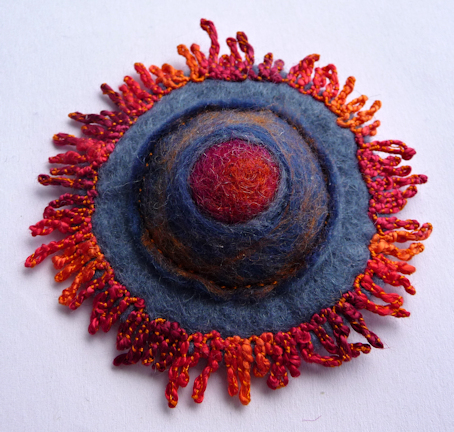
My final experiment was this brooch idea, combining the felt I'd made with a bit of free machining on dissolvable fabric.        
It's a felt bead trapped in flat felt as it was made, then revealed as an "inclusion". I cut out the circle, then stitched it onto a larger circle of felt that I'd edged with cable stitch worked on Solufleece.

I focussed so much on learning all the new techniques that I ran out of time for making finished pieces. But I still want to make myself a cord necklace, with slider beads and inclusions.

It was wonderful to find I could make small felt pieces at my desk without getting water everywhere. Now I know that I'll definitely do more wet felting to combine with my stitching.
  

Tuesday, 7 August 2018

July Samples

18/27 Cyanotype
Typically, the long sunny spell was almost over when I remembered my cyanotype fabric. Well it's been put aside for along time, as I never seemed to get the right conditions for sun printing at my last house.

So on a still, sunny day with just an hour to spare I got to work (or rather, play!). First snag - the fabric was one large, very creased piece. Have you tried ironing and cutting up fabric in the dark?! I didn't want to risk activating the chemicals until I was ready to print.     

I rushed around the garden grabbing plants to act as resists. Then I arranged them on the fabric, covered with a piece of glass, and let the sun loose on it. This is what happened:
Magic! I couldn't wait to try again.

As well as more plants, I made some negative transparencies from digital photos. My photos mostly didn't have enough contrast, but I liked this one of Talisker Bay:
What do you mean, you can do this in Photoshop - where's the fun in that?!
But what to do with these prints? So far I've made a couple of pocket mirrors and a tiny accordion book.
   

18/28 Simmer Dim
This far north it never gets totally dark around midsummer. It’s very confusing, we keep losing track of the time and going to bed far too late! In Shetland this long summer twilight is called the Simmer Dim. This is what midnight looks like from our window onto the bay on a cloudless night:
Those colours! I decided to knit them, maybe it was the Shetland association suggesting that? For little bits of lots of colours I chose tapestry wools – my stash is HUGE from bargain lots snapped up over the years. I still didn't have the right shades, buy hey it's only meant to be "inspired by", not a faithful copy. I knitted a strip in garter stitch with colour changes on the “wrong” side to help the colours shift more gradually.
But knitting alone’s not enough for me, I needed a twist… so I used the embellisher to attach the knitting to felt, flattening and stabilising it too. Then a bit of hand stitching to soften some colour shifts and highlight others.
 
Not one of my favourite samples, but knitting needled onto felt certainly has potential? It makes a lovely firm fabric, ready lined for a little purse, cuff, or… all sorts of possibilities!  

18/29 Cotton Grass
Drifts of cotton grass or bog cotton on damp areas always make me smile - it's a weird but lovely plant, unlike anything else.
I backed a little scrap of Harris tweed with pelmet Vilene to allow free machining, then stitched lots of stalks in Gutermann variegated green/brown cotton. The “cotton” heads were then created by needle felting tiny clumps of bamboo fibres on. I did this by hand with a single needle. Of all the fibres in my stash the bamboo seemed the best match, though really it should be whiter.

18/30 Rosebay Willowherb
In July and August the drifts of this wildflower, aka fireweed make a spectacular splash of colour.

I didn't mind whether my rosebay sample was machine or hand embroidered, so I had a look at all kinds of threads.

Nothing seemed quite the right colour - even on my massive Madeira shade card! Ah well, may as well use the machine then.
Back to my favourite technique - doodling with the Bernina on dissolvable fabric. I used different colours on the bobbin and spool to get closer to the actual pink/mauve. And added some bright yellow ragwort for contrast, as the two plants are often together round here.